
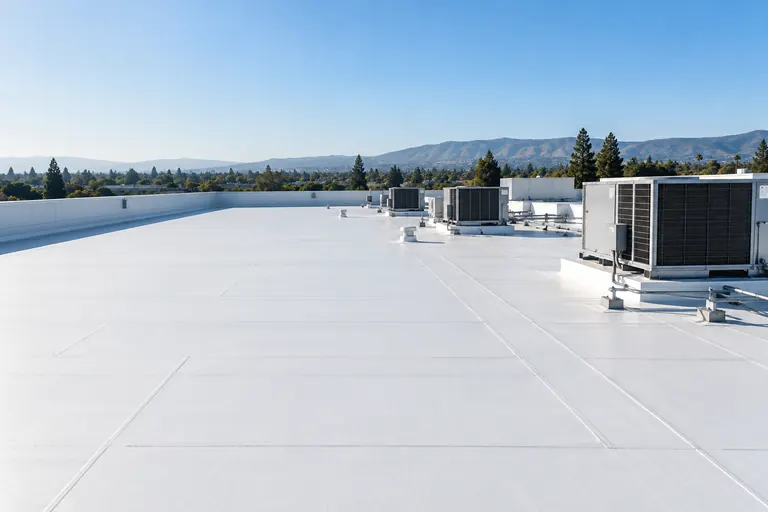
Under California's 2025 Energy Code, replacing, recovering or recoating more than 50% of a nonresidential roof, or more than 2,000 square feet, whichever is less, triggers cool roof requirements. Low-slope roofs need a CRRC-rated surface with aged solar reflectance of at least 0.63 and thermal emittance of at least 0.75, or an SRI of at least 75.
This covers the 2025 Energy Code for nonresidential buildings. Multifamily and HOA buildings follow separate code sections that aren't covered here.
When does Title 24 apply to a re-roof?
The rules apply when more than 50% of the roof area or more than 2,000 square feet, whichever is less, is replaced, recovered or recoated (Energy Code §141.0(b)2B; CEC 2025 Nonresidential Cool Roofs FAQ). In plain numbers:
- On a 3,000 sq ft roof, anything over 1,500 sq ft triggers the rules.
- On a 40,000 sq ft roof, anything over 2,000 sq ft triggers them.
Roofs over unconditioned space don't trigger these rules (CEC FAQ). Small repairs under the threshold don't trigger them either.
Cool roof values for low-slope roofs
Low-slope roofs (less than 2:12) need a CRRC-rated surface with aged solar reflectance of at least 0.63 and thermal emittance of at least 0.75, or an SRI of at least 75 (§141.0(b)2B; BayREN 2025 guide). White TPO and PVC membranes are common CRRC-rated choices.
- What “aged” means: the Cool Roof Rating Council (CRRC) publishes 3-year aged values. Where a field-applied coating has only an initial value, the code estimates the aged value as 0.2 + β(initial − 0.2), with β = 0.65 for field-applied coatings (CEC FAQ).
- How to check a product: search the CRRC Rated Products Directory for the product ID on the bid.
Steep-slope roofs (and barrel roofs)
- Climate zones 1 and 3: aged solar reflectance of at least 0.20 and thermal emittance of at least 0.75, or SRI 16.
- Climate zones 2 and 4–16: at least 0.25 and 0.80, or SRI 23.
- Barrel roofs are treated as steep-slope (CEC FAQ). For metal, see commercial metal roofing.
Most of the Bay Area is in climate zones 3, 4 and 12. On the CEC's ZIP-code list, San Francisco, Oakland and the San Mateo County ZIPs we checked are in zone 3; San Jose and the Santa Clara, Mountain View and Milpitas ZIPs we checked are in zone 4; Walnut Creek, Concord and Pleasanton are in zone 12. Check your ZIP code on the CEC climate zone tool.
Insulation when you replace the roof
For a nonresidential low-slope commercial roof replacement over conditioned space, the code calls for R-23 continuous insulation in climate zones 1–5 and 9–16 (Table 141.0-C), with alteration tradeoff options in Table 141.0-B.
- Rooftop equipment left in place: where equipment isn't disconnected and lifted, the requirement drops to the greater of R-10 or the most insulation that still keeps the manufacturer's base-flashing height (§141.0(b)2B exceptions; CEC FAQ).
- Tapered insulation at drains can count toward the average R-value.
- Why it matters for bids: added insulation raises curb, drain and flashing heights, which adds work and cost around every penetration.
Does a roof coating count?
- Recoating counts toward the trigger. The 50% / 2,000 sq ft rule includes “recoated,” so a large coating job must meet the cool roof values. See restoration and coatings and roof coating chemistries.
- Recoats don't trigger the insulation requirement (CEC FAQ).
- Full coverage: field-applied coatings are applied across the entire roof surface at the manufacturer's specified dry mil thickness (§110.8(i)4).
- Wildland-urban interface areas: a coating isn't an approved way to meet the roof-assembly fire requirement (California Wildland-Urban Interface Code 503.2.5).
What this means for your bids
Ask each bidder to state in writing:
- Whether the job triggers Title 24, and why or why not.
- The CRRC product ID they're pricing.
- The insulation they're including (R-value, or why it's reduced).
- Who files the compliance forms.
For more on lining bids up, see how to compare commercial roofing bids and our pages for facility managers and property managers.
Local rules on top of Title 24
San Francisco's Better Roofs requirements apply to new construction only, not re-roofs (SF Planning Zoning Administrator Bulletin No. 11). See commercial roofing in San Francisco. Some cities, including San Francisco, ask cool-roof questions on their re-roof permit applications (SF DBI).
Sources
- California Energy Commission, Energy Code Support Center (2025 Nonresidential Cool Roofs FAQ)
- California Energy Commission, 2025 Building Energy Efficiency Standards (§141.0(b)2B, Tables 141.0-B and 141.0-C, §110.8(i)4)
- California Energy Commission, Climate Zone tool, maps and information
- BayREN, 2025 Nonresidential Roofing Permit Guide
- Cool Roof Rating Council, Rated Products Directory
- California Wildland-Urban Interface Code 503.2.5
- SF Planning, Zoning Administrator Bulletin No. 11 (Better Roofs)