
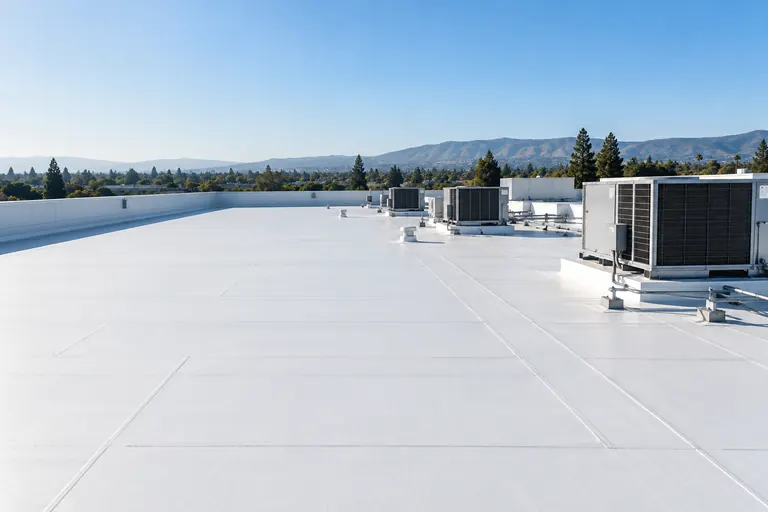
Roof systems · Modified bitumen
Modified Bitumen Roofing: Repairs, Re-Roofs and Torch-Down Safety on Commercial Buildings
For older flat roofs on multifamily, mixed-use and small commercial buildings with a mod-bit cap sheet that's blistering, splitting or leaking at the laps.
- Free roof condition report
- Good, better and best options
- Certificate of insurance within 24 hours of request
What modified bitumen is
Modified bitumen is asphalt modified with rubber-like polymers, made in rolls and installed as a multi-ply system: a base sheet plus a cap sheet. There are two families, each with its own ASTM specifications:
- SBS (styrene-butadiene-styrene): ASTM D6162 (polyester and glass), D6163 (glass) and D6164 (polyester).
- APP (atactic polypropylene): ASTM D6222 (polyester) and D6223 (polyester and glass).
The sheets can be torch-applied, set in hot-mopped asphalt, cold-adhered, or self-adhered.
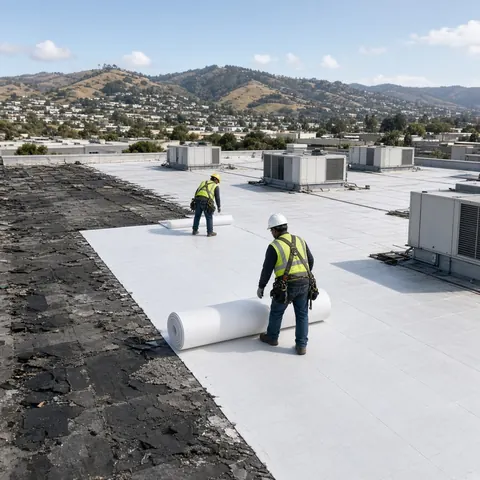
Illustrative image, not a completed project.
Where you'll see mod bit in the Bay Area
On older flat roofs of San Francisco and Oakland multifamily and mixed-use buildings, on small commercial buildings, and on the flat sections of HOA buildings.
Where mod-bit roofs fail
Blisters and open laps
Blisters in the cap sheet and seams separating at the laps.
Granule loss
Bare spots that expose the asphalt to UV.
Base flashing at parapets
Cracked or loose flashing where the roof turns up the wall.
Patches over patches
Stacked repairs that no longer hold.
Ponding at drains
Standing water that ages the cap sheet.
Splits at deck joints
Cracks over movement in the deck below.
Repair, coat or re-roof?
| Option | Usually fits when |
|---|---|
| Repair | Blisters, laps and flashings are localized and can be patched with compatible mod-bit or cold-applied materials. |
| Coat | The mod bit is sound and dry, with a compatible coating and an adhesion test. In wildland-urban interface areas, coatings and paints aren't approved protection methods (California Wildland-Urban Interface Code 503.2.5); see Santa Cruz County. |
| Re-roof | The insulation is wet, laps are failing across the roof, or the roof has already been recovered. |
The building code doesn't allow a recover over a water-soaked or deteriorated roof, or one that already has two or more coverings (CBC 1512.2.1, as listed in Milpitas's 2026 commercial re-roof handout). A roof condition report shows which you have.
Torch-down: what the fire code requires
Installing torch-applied roof systems is hot work under the 2025 California Fire Code. Roofing operations with open flames or other ignition sources fall under §3305.10 and Chapter 35.
- Permit: hot work needs the permit required by §105.5 (§3501.2).
- Pre-hot-work check: before work starts, a check confirms the equipment is safe, combustibles are clear or protected, openings are protected, and fire watches and extinguishers are in place (§3504.3.1).
- Fire watch: “A fire watch shall be provided during hot work activities and shall continue for not less than 30 minutes after the conclusion of the work.” The fire code official, or the responsible manager under a hot work program, can extend it (§3504.2.1).
- Extinguisher: at least one portable fire extinguisher with a minimum 2-A:20-B:C rating, with ready access within 30 feet of the hot work (§3504.2.6).
San Francisco's reroofing permit application asks whether the job involves hot work. Cold-adhered and self-adhered sheets avoid open flame near combustible parapets, wood decks and occupied units.
Mod bit and Title 24 cool roofs
On a qualifying nonresidential low-slope re-roof (more than 50% of the roof area or more than 2,000 square feet, whichever is less (Energy Code §141.0(b)2B)), the new surface needs aged solar reflectance of at least 0.63 and thermal emittance of at least 0.75, or an SRI of at least 75, with a CRRC label (§140.3(a)1A). Many standard granulated cap sheets don't reach that, so the usual options are a CRRC-rated reflective cap sheet or a CRRC-rated coating. Check the specific product's CRRC listing. Our Title 24 re-roof guide walks through the trigger, the cool roof values and the insulation rule.
Exceptions include roof constructions weighing at least 25 lb per square foot (heavy ballast or pavers), roof area under building-integrated PV, and a U-factor tradeoff. Minor leak repairs don't need CRRC-rated products (CEC 2025 Nonresidential Cool Roofs FAQ; Energy Code). HOA and multifamily buildings follow different Title 24 sections.
Mod bit vs. single-ply
Mod bit's multiple plies give it redundancy and puncture tolerance. Single-ply membranes such as TPO and PVC are white and reflective, with heat-welded seams. Which fits depends on the deck, foot traffic, rooftop equipment and the cool-roof requirement. Mod bit is also a common replacement for older built-up (tar and gravel) roofs.
Where we work
Commercial, industrial, multifamily and HOA roofing across six Bay Area counties.
- Santa Clara County, CASan Jose, Santa Clara, Sunnyvale, Mountain View, Palo Alto, Milpitas
- San Francisco County, CASan Francisco
- San Mateo County, CARedwood City, San Mateo, South San Francisco, Burlingame, Foster City
- Alameda County, CAOakland, Fremont, Hayward, Newark, Pleasanton, Berkeley
Frequently Asked Questions
Yes, as regulated hot work. The California Fire Code requires the hot-work permit the local fire code official requires, a pre-hot-work check of the area, a portable extinguisher rated at least 2-A:20-B:C within 30 feet, and a fire watch during the work and for at least 30 minutes after. Cold- and self-adhered sheets avoid open flame.
Usually. Blisters, open laps and cracked base flashing can be cut out and patched with compatible mod-bit or cold-applied materials. Stacked patches, widespread lap failure or wet insulation are signs a re-roof is the better spend. A condition report that checks for moisture tells you which you have.
Both are polymer-modified asphalt sheets. SBS uses a rubbery polymer and can be torched, mopped, cold-adhered or self-adhered. APP uses a plastic-like polymer and is usually torch-applied. ASTM publishes separate specifications for each, D6162 to D6164 for SBS and D6222 to D6223 for APP, based on reinforcement.
It can, on nonresidential low-slope roofs, if the surface is CRRC-rated with at least 0.63 aged reflectance and 0.75 emittance, or SRI 75. Many standard granulated cap sheets fall short, so jobs above the size threshold use a reflective cap sheet or a rated coating. Very heavy roofs (25 lb per square foot or more) are exempt.
Sometimes. California's building code allows a recover over a sound, dry roof, but not over a water-soaked or deteriorated roof or one that already has two or more coverings. A moisture survey and a core cut show whether a recover is allowed or the roof must come off to the deck.
Let's get started
Request a mod-bit repair or re-roof bid
Tell us the property, the building type and what's happening on the roof. For an active leak, call.
- (408) 770-5992Calling is fastest for an active leak