
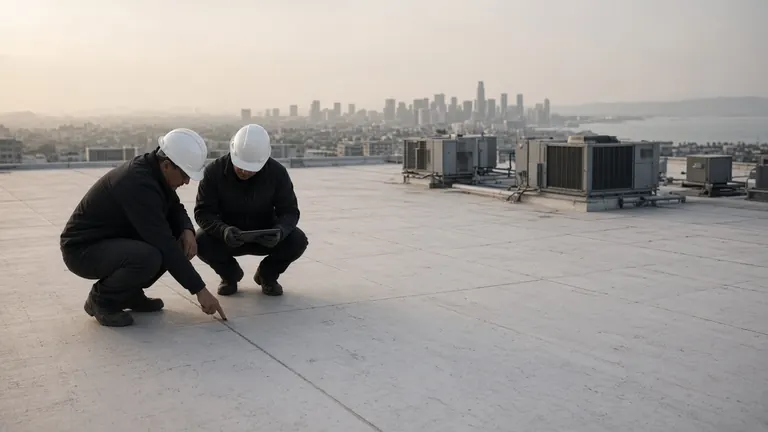
Inspections & condition reports
Commercial Roof Inspections and Condition Reports
A free roof condition report: photos, findings and options you can forward.
- Free roof condition report
- Good, better and best options
- Certificate of insurance within 24 hours of request
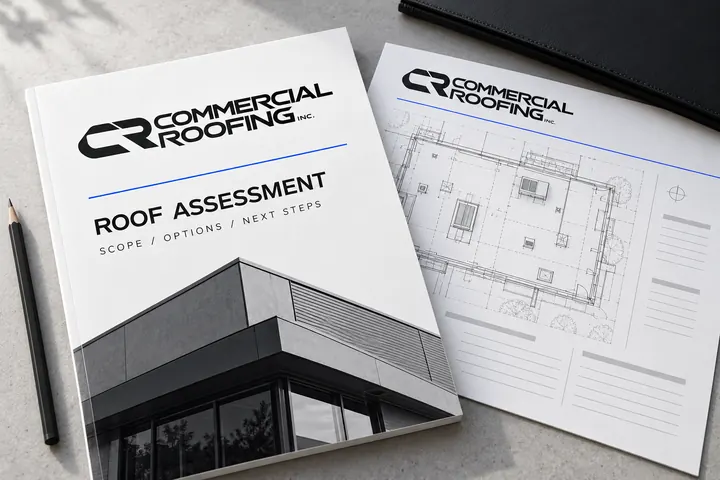
Illustrative mockup, not an issued project document.
What you get
What's in the roof condition report
A written report you can forward to an owner, lender, insurer or board.
- Photos of what was found on the roof
- The roof system identified
- Drains, seams, flashings, curbs, penetrations, edge metal and rooftop equipment areas checked
- Options to repair, coat or replace, priced as good, better and best
Is the inspection really free?
Yes. The roof condition report is free and there's no obligation to buy anything. The report includes options, and "repair only" is one of them when that's what the roof needs.
A good test for any free inspection: ask what you'll receive in writing. If the answer isn't a photo-documented report with options, it's a sales visit. A roof condition report is not a property condition assessment (PCA), a reserve study or a structural engineer's evaluation, and doesn't replace one.
When to schedule a commercial roof inspection
Before the rainy season
About 82% of San Jose's annual rain falls from November through March (National Weather Service). Inspect and clear drains in September and October.
After a major storm
Roofing manufacturers' maintenance guides commonly recommend regular semi-annual checks and inspections after severe weather. To keep every roof on that schedule, see commercial roof maintenance programs.
For the HOA reserve study
California's Davis-Stirling Act requires a visual inspection of major components every three years. See HOA and condo roofing.
Before a sale, refinance or lease-up
Buyers, lenders and tenants ask about roof condition. A dated, photo-documented report answers the question.
Before solar or rooftop equipment changes
New penetrations and equipment on an aging roof are easier to plan when its condition is known.
When planning a re-roof or recoat
On nonresidential low-slope roofs, California's Energy Code applies cool-roof requirements when the area replaced, recovered or recoated is more than 50% of the roof or more than 2,000 square feet, whichever is less (Energy Code §141.0(b)2B). The new surface must be a CRRC-rated product that meets the code's reflectance and emittance minimums, and a re-roof over conditioned space in Bay Area climate zones 3, 4 and 12 generally also needs R-23 continuous insulation (BayREN, Table 141.0-C). Recoats are exempt from the insulation rule. See commercial roof replacement and restoration and coatings. Multifamily and HOA buildings follow different Title 24 rules. Measuring the roof areas up front helps get the bid scope right. Our Title 24 re-roof guide walks through the trigger, the cool roof values and the insulation rule.
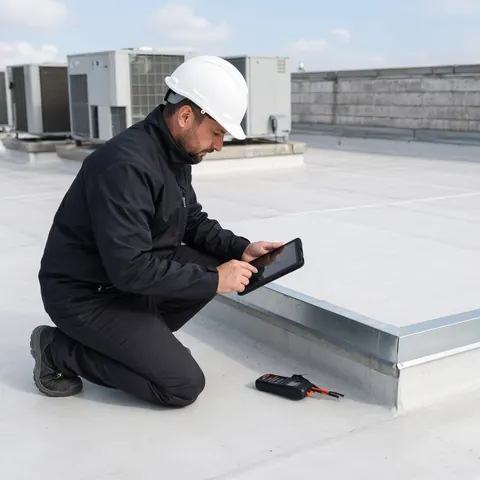
Illustrative image, not a completed project.
How the inspection works
Access
Who needs to be on site, and how to reach the roof: hatch, ladder or stairs.
Interior check
Known leak locations and stains inside, so they can be traced on the roof.
Roof walk
Field, seams, flashings, drains, penetrations and edge metal, photographed.
Report
Photos, findings and good, better and best options in writing.
Review
A call to walk through the report and the next step, if any.
What we look at on Bay Area roofs
Drains and scuppers
Debris left after the dry season, the most common cause of first-storm leaks.
Flashing at parapets and curbs
Shrinkage, open laps and failed counter-flashing where the roof meets walls and equipment.
Seams
Lap seams on TPO and PVC single-ply membranes.
Blistering
Blisters and splits on modified bitumen and built-up roofs.
Coating wear
Thinning, chalking and exposed substrate on coated roofs.
Penetrations
Rooftop HVAC, conduit, solar mounts and pipe boots.
Coastal corrosion
Rusting sheet metal near the coast in San Francisco, the San Mateo coast and Santa Cruz.
UV and heat aging
Faster aging inland, in the South Bay, Contra Costa and the Tri-Valley.
Ponding
Areas where water sits after rain, adding load and stress to seams.
Inspections for property managers, HOAs and facility teams
Property managers
A report to forward to the owner when building the capex plan or answering an insurer or lender.
HOA boards & community managers
Photo evidence for the reserve specialist and the board ahead of the reserve-study update.
Facility teams
A baseline for a roof asset plan, and a check before rooftop equipment or solar work.
Where we work
Commercial, industrial, multifamily and HOA roofing across six Bay Area counties.
- Santa Clara County, CASan Jose, Santa Clara, Sunnyvale, Mountain View, Palo Alto, Milpitas
- San Francisco County, CASan Francisco
- San Mateo County, CARedwood City, San Mateo, South San Francisco, Burlingame, Foster City
- Alameda County, CAOakland, Fremont, Hayward, Newark, Pleasanton, Berkeley
Frequently Asked Questions
A useful commercial roof inspection identifies the roof system and documents its condition with photos. It covers the field, seams, flashings, drains, penetrations and edge metal, then lays out options to repair, coat or replace. Ours ends in a written report you can forward to an owner or board.
Roofing manufacturers' maintenance guides commonly recommend inspections at least twice a year and after severe weather. In the Bay Area, schedule one in September or October, before the November–March rains, and another in spring to plan dry-season repairs. HOAs also need the reserve study's three-year visual inspection.
Ask what you'll receive in writing. A free inspection is worth it when it produces a photo-documented report with options, including "repair only", and no obligation. Ours includes good, better and best options so you can compare them against other bids.
California's Davis-Stirling Act requires a reserve study with a visual inspection of major components, including roofs, every three years. The reserve specialist does that study, but a roofer's photo-documented condition report gives the specialist and the board better evidence about each roof's condition and repair needs.
Let's get started
Request a free roof condition report
Tell us the property address, building type, approximate roof size and why you want the inspection (pre-storm, reserve study, sale or refinance, leak history, re-roof planning).
- (408) 770-5992Calling is fastest for an active leak