
Roof systems · TPO
TPO Roofing for Commercial Buildings: Repair, Re-Roofing and What to Check
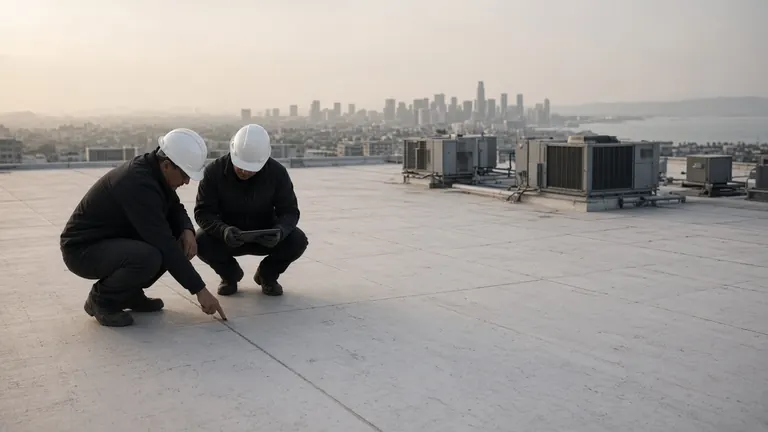
For tilt-ups, R&D buildings, offices and HOA flat sections with a TPO roof that's leaking or due for replacement.
- Free condition report: repair, coat or replace?
- Good, better and best options
- Certificate of insurance within 24 hours of request
What TPO is, in one minute
TPO (thermoplastic polyolefin) is a single-ply roofing membrane, typically white, with heat-welded seams. It's installed mechanically attached, fully adhered, or with induction-welded plates. The standard material specification is ASTM D6878.
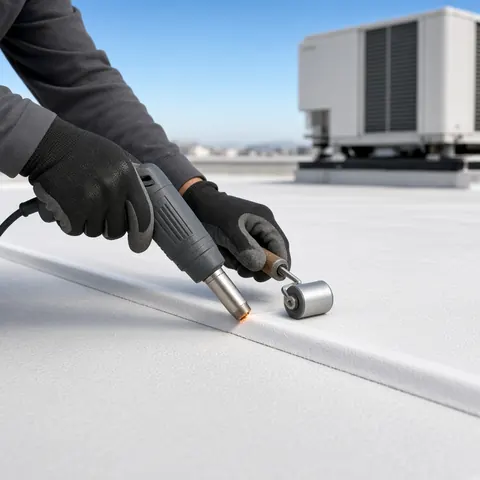
Illustrative image, not a completed project.
Where TPO shows up on Bay Area buildings
TPO is the most common re-roof system on the region's low-slope stock. Kidder Mathews counts about 109 million square feet of R&D space in Silicon Valley and 211.6 million square feet of industrial space in the East Bay (Q3 2026), much of it in concrete tilt-ups from the 1960s through the 1980s, along with offices, retail centers and flat sections on HOA buildings.
Where TPO roofs fail
Seams
Poor welds or contamination at the weld.
Flashings
At curbs and parapets, where the membrane turns up.
Penetrations
Pipes, conduit and equipment supports.
Punctures
Rooftop traffic and HVAC service.
Fastener back-out
On mechanically attached roofs.
Ponding
At blocked drains. Standing water adds roughly 5 lb per square foot for every inch of depth.
Repair, coat or re-roof a TPO roof?
| Option | Usually fits when |
|---|---|
| Repair | Seam or flashing failures are localized and the membrane is still clean and weldable. Probing seams is standard practice. |
| Coat | The TPO is sound, with a compatible primer and an adhesion test on the actual roof, and seams and wet areas are repaired first. |
| Re-roof | Seams are failing across the roof, the membrane is brittle, or the insulation is wet. |
A moisture survey tells you whether coating or re-roofing makes more sense. Start with a free roof condition report.
TPO and Title 24
White TPO products are commonly CRRC-listed. Above the code's size threshold, a nonresidential low-slope alteration needs aged solar reflectance of at least 0.63 and thermal emittance of at least 0.75, or an SRI of at least 75, with a CRRC label (CEC; BayREN). Check the specific product's CRRC listing for its aged values.
A re-roof over conditioned space generally adds continuous insulation, R-23 in climate zones 3 and 4. Roof area over unconditioned warehouse or process space isn't counted toward the cool-roof size test (BayREN), which matters for a tilt-up with an office front and a warehouse behind. Our Title 24 re-roof guide walks through the trigger, the cool roof values and the insulation rule.
TPO vs. PVC
Both are single-ply, heat-welded membranes. The difference that usually decides it is what comes out of the rooftop equipment.
| TPO | PVC (KEE) | |
|---|---|---|
| Seams | Heat-welded | Heat-welded |
| Common on | Tilt-ups, R&D, offices and retail without grease exposure | Restaurants and food processing |
| Grease or chemical exhaust | Check the manufacturer's guidance | KEE PVC is commonly specified for grease resistance (manufacturer guidance) |
The fuller comparison, including grease exposure and Title 24, is on PVC roofing. For older rubber roofs, see EPDM roofing.
Who we see with TPO roofs
Tilt-up and flex owners
A TPO re-roof from decades ago, now with seam or flashing leaks.
Property managers
A photo-documented repair-or-replace answer to forward to the owner.
HOA boards
TPO-covered flat sections over garages and podiums.
Where we work
Commercial, industrial, multifamily and HOA roofing across six Bay Area counties.
- Santa Clara County, CASan Jose, Santa Clara, Sunnyvale, Mountain View, Palo Alto, Milpitas
- San Francisco County, CASan Francisco
- San Mateo County, CARedwood City, San Mateo, South San Francisco, Burlingame, Foster City
- Alameda County, CAOakland, Fremont, Hayward, Newark, Pleasanton, Berkeley
Frequently Asked Questions
It's one of the most common choices for re-roofing low-slope tilt-ups. It's a white, heat-welded single-ply membrane that can meet California's cool-roof rules. Whether it fits your building depends on the deck, drainage, rooftop traffic and what's under the roof. Grease or chemical exhaust usually points to PVC instead.
Usually, if the membrane is still clean, flexible and weldable. Seam and flashing leaks are repaired by cleaning and re-welding or adding a welded patch. If seams are failing across the roof, the membrane has become brittle, or insulation underneath is wet, a coating or re-roof is the better path.
Many white TPO products are CRRC-rated and meet the nonresidential low-slope minimums of 0.63 aged solar reflectance and 0.75 thermal emittance, or SRI 75. Check the specific product's CRRC listing for its aged values. A re-roof over conditioned space usually adds continuous insulation, too.
Yes, when the TPO is sound. Coating TPO needs a compatible primer and an adhesion test on the actual roof, plus repairs to seams and wet areas first. It's not a fix for widespread seam failure. A moisture survey tells you whether coating or re-roofing makes more sense.
Where kitchen exhaust puts grease on the roof, manufacturers commonly recommend KEE PVC because of its grease resistance. TPO is widely used on retail and office roofs without that exposure. Look at what comes out of the rooftop equipment before choosing.
Let's get started
Request a TPO re-roof bid
Tell us the property, roof size if you know it, and whether it's a leak, a repair or a re-roof. For an active leak, call.
- (408) 770-5992Calling is fastest for an active leak