
Roof repairs & leak response
Commercial Roof Repair and Leak Response in the Bay Area
For leaks at commercial, industrial and HOA buildings. Call for an active leak, or request a repair scope for a known problem.
- Free roof condition report
- Good, better and best repair options
- Certificate of insurance within 24 hours of request
Roof leaking right now? Do these five things first
Keep people safe, protect what's under the leak, and document it before anything is cleaned up. Then call. Nobody should go up on the roof during a storm.
- Make the area safe. Keep people away from wet floors and sagging or stained ceiling tiles, and have power shut off to anything that is getting wet.
- Move or cover contents. Shift equipment, inventory and furniture, and cover what can't be moved.
- Photograph it before cleanup. Ceiling, floor, walls and anything damaged.
- Note the exact interior location. Suite, room and the nearest column line or fixture help trace the source on the roof.
- Call (408) 770-5992. Calling is the fastest way to reach us; the form is best for non-urgent requests.
Then find the roof warranty, if there is one, and check its notice clause. Some manufacturer warranties require written notice within a set window.
What happens on a leak call
Leak tracing: why the leak usually isn't above the stain
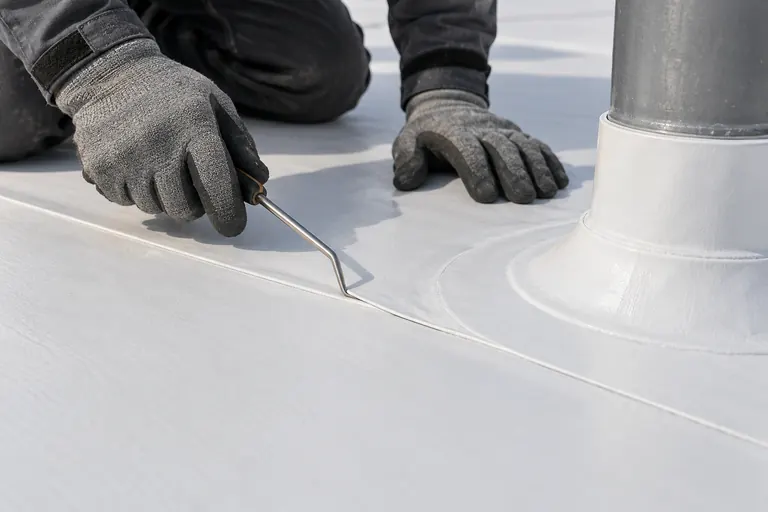
On a low-slope roof, water rarely drops straight down. It gets in at a seam, flashing or penetration, then travels under the membrane or along the deck before it shows inside. A repair should start with tracing from the interior location to the roof, not a patch above the stain.
Temporary vs. permanent repair
In active rain, the goal is to stabilize: divert water, clear drains and make a temporary seal. A lasting repair needs a dry, clean surface and materials matched to the roof, so the permanent fix normally follows once the cause is confirmed and documented. More in our guide to temporary vs. permanent roof leak repairs.
Repairs matched to the membrane
Repair methods differ by system: heat-welded seams on TPO and PVC, compatible adhesives or liquid flashing on EPDM, and appropriate methods for built-up and modified bitumen roofs. The repair should be compatible with your roof system and any existing warranty.
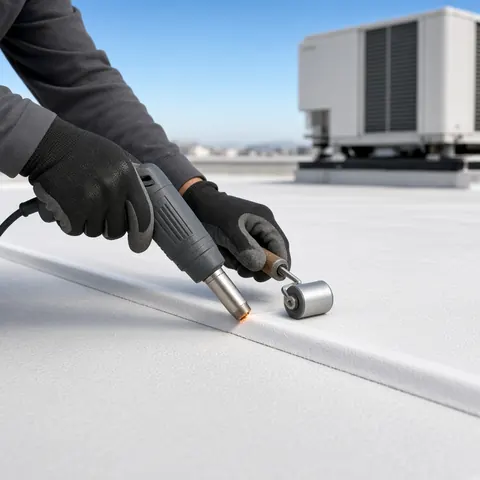
Illustrative image, not a completed project.
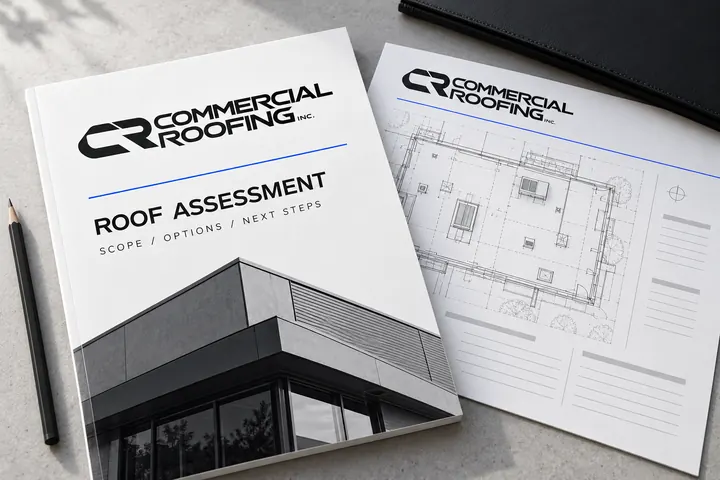
Illustrative mockup, not an issued project document.
In writing
The report you get after the repair
One document you can forward to the owner, asset manager or board.
- Photos of the leak source and of the finished repair
- Other deficiencies noticed on the roof, such as ponding, edge metal or flashing
- Options to repair, coat or replace, priced as good, better and best
- A certificate of insurance within 24 hours of request
Common commercial roof leak sources
A pattern, not a statistic: these are the usual suspects on Bay Area low-slope roofs.
Clogged drains and scuppers
After a dry summer, the first heavy rains find leaves and debris in drains and scuppers. Water backs up and finds a seam or flashing.
Flashing at curbs and parapets
Where the membrane turns up a wall, curb or parapet, flashing ages, shrinks and pulls away. See flashing, sheet metal and drainage.
Seams
Lap seams on single-ply and modified bitumen roofs open with movement, heat cycles and age.
Pipe boots and penetrations
Boots split, sealant dries out, and new penetrations get added without proper flashing.
Rooftop HVAC and solar
Equipment curbs, conduit and solar mounts add penetrations and foot traffic.
Ponding water
Water that sits after rain stresses seams and adds load: roughly 5 lb per square foot for every inch of depth.
Repair, coat or replace? How to tell
A photo-documented inspection with moisture checks is how you tell which one fits. Where more than one is reasonable, the options are priced side by side.
| Option | Usually fits when |
|---|---|
| Repair | Damage is localized and the rest of the roof is sound. |
| Coat / restore | The deck is sound and wet insulation is limited. |
| Replace | Moisture is widespread, failures keep recurring, or the roof is at the end of its life. |
Large repairs can cross code thresholds. On nonresidential low-slope roofs, California's Energy Code applies cool-roof requirements when the area replaced, recovered or recoated is more than 50% of the roof or more than 2,000 square feet, whichever is less (Energy Code §141.0(b)2B). The new surface must be a CRRC-rated product that meets the code's reflectance and emittance minimums, and a re-roof over conditioned space in Bay Area climate zones 3, 4 and 12 generally also needs R-23 continuous insulation (BayREN, Table 141.0-C). Recoats are exempt from the insulation rule. Our Title 24 re-roof guide walks through the trigger, the cool roof values and the insulation rule.
Do commercial roof repairs need a permit?
It depends on the size of the repair and the city.
- San Jose: repairs or replacements under 25% of the roof that don't involve framing, done no more than once in 12 months, are exempt. At 25% or more, a building permit is required (San José Building Division Bulletin #201). See commercial roofing in San Jose.
- San Francisco: the Department of Building Inspection requires a permit before installing, repairing or removing roofing material, with exemptions in SF Building Code §106A.2 item 13. Only a licensed C-39 roofing contractor can apply online (SF.gov). See commercial roofing in San Francisco.
- Other cities: each building department sets its own threshold. Permit applicability is reviewed for your specific project during scoping rather than assumed.
Who we repair roofs for
Property managers
A photo-documented cause, a line-item repair scope to forward to the owner, and a COI within 24 hours of request.
HOA boards & community managers
A resident's ceiling leak traced to its source, with good, better and best options for the board.
Owners & facility teams
A straight answer on whether a repair is enough, with no push toward replacement when it isn't needed.
Where we work
Commercial, industrial, multifamily and HOA roofing across six Bay Area counties.
- Santa Clara County, CASan Jose, Santa Clara, Sunnyvale, Mountain View, Palo Alto, Milpitas
- San Francisco County, CASan Francisco
- San Mateo County, CARedwood City, San Mateo, South San Francisco, Burlingame, Foster City
- Alameda County, CAOakland, Fremont, Hayward, Newark, Pleasanton, Berkeley
Frequently Asked Questions
Make the area safe first: shut off power to anything getting wet, keep people away from wet or sagging ceilings, and move or cover equipment. Photograph the damage before cleanup and note exactly where the water is coming in. Then call a commercial roofer and check your roof warranty for a notice requirement.
Usually only temporarily. In active rain, water can often be stopped or diverted with temporary seals and cleared drains. A lasting repair needs a dry, clean surface and materials matched to the membrane, so the permanent fix normally follows once the weather breaks and the cause is confirmed.
Water rarely drops straight down on a low-slope roof. It enters at a seam, flashing or penetration, then travels under the membrane or along the deck before it shows inside. That's why a repair should start with leak tracing on the roof, not a patch directly above the stain.
It depends on size and city. San Jose exempts repairs under 25% of the roof that don't involve framing, done no more than once in 12 months; 25% or more needs a permit. San Francisco's DBI requires a permit for roofing work unless a code exemption applies. Confirm before work starts.
Repair when the damage is localized and the rest of the roof is sound. Consider a coating when the deck is sound and wet insulation is limited. Replace when moisture is widespread, failures keep recurring or the roof is at the end of its life. A photo-documented inspection is how you tell.
Call (408) 770-5992. Calling is the fastest way to reach us. Tell us where the water is showing, what's underneath it and how to access the roof, so the visit can be prioritized and planned.
It can, if the repair uses incompatible materials or the manufacturer wasn't notified when required. Find the warranty, check its notice and contractor terms, and share it with the roofer before work begins.
Photos of the leak source and the completed repair, other deficiencies noticed on the roof, and options to repair, coat or replace priced as good, better and best, so you can forward one document to the owner or board.
Let's get started
Request a repair scope
Tell us where the water is showing and how to reach the roof. For an active leak, call.
- (408) 770-5992Calling is fastest for an active leak