
Roof systems · Built-up (BUR)
Built-Up and Tar-and-Gravel Roofs: Repair, Restore or Replace
For older office, retail, light-industrial and apartment buildings with a gravel-surfaced roof that keeps leaking.
- Free roof condition report: repair, coat or replace?
- Good, better and best options
- Certificate of insurance within 24 hours of request
What a built-up roof is
A built-up roof (BUR) is assembled on site from alternating layers of roofing felt and bitumen, either hot asphalt or coal tar, and usually finished with gravel or a mineral-surfaced cap. Asphalt used in roofing is specified under ASTM D312, “Standard Specification for Asphalt Used in Roofing.”
You'll still find built-up roofs on older commercial, retail and multifamily buildings across the Bay Area.
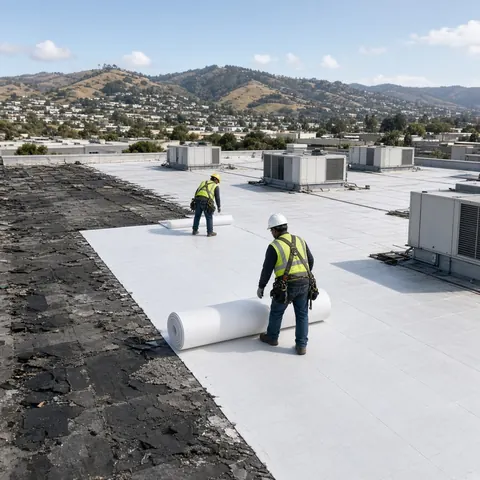
Illustrative image, not a completed project.
Where built-up roofs fail
Blisters and splits
Blisters between the plies and splits in the felts.
Bare spots
Gravel migrates and the exposed bitumen weathers.
Flashing failures
At parapets, curbs and penetrations.
Ponding
Standing water at clogged drains and scuppers.
Hidden leaks
Gravel hides the damage, so leaks are hard to trace back to their source.
Repair, restore or replace a BUR roof?
| Option | Usually fits when |
|---|---|
| Repair | Blisters, splits and flashing leaks are localized and can be cut out and patched with compatible asphalt materials, following the manufacturer's instructions. |
| Restore or coat | The roof is dry and sound, loose gravel has been dealt with, and a coating the manufacturer lists for the surface passes an adhesion test. Chemistry: roof coating systems. |
| Replace | The insulation is wet, the felts are failing across the roof, or the roof already has two or more layers. |
The building code doesn't allow a recover over a water-soaked or deteriorated roof, or one that already has two or more coverings (CBC 1512.2.1, as listed in Milpitas's 2026 commercial re-roof handout). A moisture survey tells you which case you're in. See roof condition reports.
Asbestos survey before a tear-off
In the Bay Area Air District, which covers Alameda, Contra Costa, San Francisco, San Mateo and Santa Clara counties, Regulation 11, Rule 2 requires the owner or operator to survey the affected part of a structure for asbestos-containing material before any renovation or demolition, including nonfriable material. The survey is done by an inspector who holds Cal/OSHA certification and has passed an EPA-approved Building Inspector course, with sampling and lab results. The district's asbestos FAQ lists roofing among suspect materials (BAAQMD Regulation 11, Rule 2; BAAQMD Asbestos FAQ).
In practice: budget time for the survey before the tear-off date. Santa Cruz County is in a different air district with its own rules.
BUR and Title 24
On a qualifying nonresidential low-slope re-roof or recover (more than 50% of the roof area or more than 2,000 square feet, whichever is less (Energy Code §141.0(b)2B)), the new surface needs aged solar reflectance of at least 0.63 and thermal emittance of at least 0.75, or an SRI of at least 75, with a CRRC label (§140.3(a)1A), and a re-roof over conditioned space generally needs continuous insulation as well (R-23 in climate zones 1–5 and 9–16, Table 141.0-C). Plain gravel rarely meets the reflectance values on its own, so a reflective cap sheet, a rated coating or a different system is usually part of the scope. Our Title 24 re-roof guide walks through the trigger, the cool roof values and the insulation rule.
Roof constructions weighing at least 25 lb per square foot over the membrane are exempt, but the weight has to be confirmed by the designer; don't assume a gravel roof qualifies. Unconditioned buildings don't trigger the cool-roof rules (CEC 2025 Nonresidential Cool Roofs FAQ).
Fire ratings are set locally: Daly City, Watsonville and Capitola require at least Class B.
BUR vs. modified bitumen vs. single-ply
| Built-up (BUR) | Modified bitumen | Single-ply (TPO, PVC) | |
|---|---|---|---|
| How it's built | Several plies of felt and bitumen assembled on site | Factory-made polymer-asphalt sheets, base plus cap | One sheet with heat-welded seams |
| Surface | Usually gravel or a mineral cap | Granulated or reflective cap sheet | Usually white |
| Repairs | Cut out and patch with compatible asphalt materials | Patch with compatible mod-bit or cold-applied materials | Heat-weld a patch to clean membrane |
| Cool-roof options | Reflective cap sheet or rated coating | Reflective cap sheet or rated coating | CRRC-rated white membranes |
No system wins across the board. The deck, the rooftop equipment and the cool-roof requirement decide it.
Where we work
Commercial, industrial, multifamily and HOA roofing across six Bay Area counties.
- Santa Clara County, CASan Jose, Santa Clara, Sunnyvale, Mountain View, Palo Alto, Milpitas
- San Francisco County, CASan Francisco
- San Mateo County, CARedwood City, San Mateo, South San Francisco, Burlingame, Foster City
- Alameda County, CAOakland, Fremont, Hayward, Newark, Pleasanton, Berkeley
Frequently Asked Questions
Often it can be repaired. Blisters, splits and flashing leaks can be cut out and patched. Replacement makes sense when the insulation is wet, the felts are failing across the roof, or there are already two layers, which the building code treats as a mandatory tear-off. A moisture survey tells you which case you're in.
In the Bay Area Air District, yes. Regulation 11, Rule 2 requires a survey for asbestos-containing material before renovation or demolition, done by a Cal/OSHA-certified inspector with lab results. Roofing is on the district's list of suspect materials. Build the survey into the schedule before the tear-off.
Sometimes. Loose gravel has to be removed or the surface prepared, the roof must be dry, and the coating has to pass an adhesion test and be listed by its manufacturer for the surface. Above the Title 24 size threshold, the coating must also be a CRRC-rated cool roof product.
On nonresidential low-slope roofs, yes, once more than half the roof or more than 2,000 square feet, whichever is less, is replaced, recovered or recoated. The surface needs a CRRC-rated cool roof product, and conditioned space generally needs added insulation. Unconditioned buildings don't trigger the cool-roof rules.
Both are asphalt-based. A built-up roof is assembled on site from several layers of felt and hot bitumen, usually with gravel on top. Modified bitumen comes as factory-made sheets that are torched, mopped, cold-adhered or self-adhered. Mod bit is a common choice when a BUR roof is replaced.
Let's get started
Request a BUR repair or re-roof bid
Tell us the property, the building type and what's happening on the roof. For an active leak, call.
- (408) 770-5992Calling is fastest for an active leak