
Restoration & coatings
Commercial Roof Coatings and Restoration: When a Coating Makes Sense and When It Doesn't
A coating can be a legitimate alternative to a re-roof, on the right roof. Here's how to tell.
- Free roof condition report
- Coat-vs-replace options, good, better and best
- Certificate of insurance within 24 hours of request
What roof restoration actually is
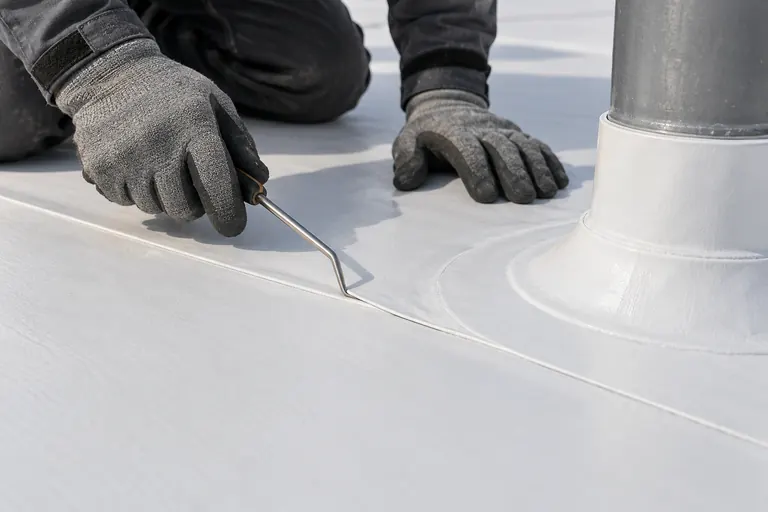
Restoration means cleaning the roof, repairing it, reinforcing seams and flashings, then applying a fluid-applied coating over a sound existing roof. It isn't a fix for a failed roof.
Common coating chemistries include acrylic and silicone, among others. Which one fits depends on the existing roof, drainage and the manufacturer's requirements.
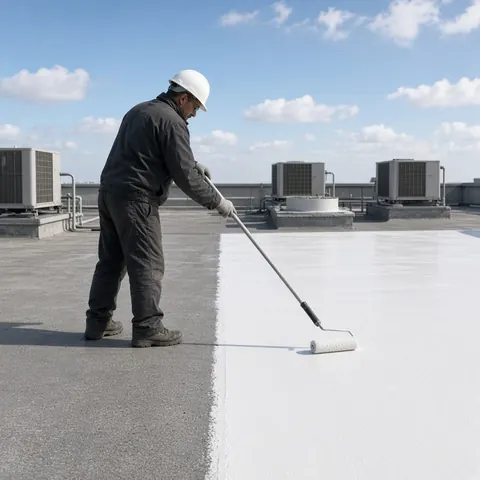
Illustrative image, not a completed project.
Illustrative mockup, not an issued project document.
The honest checklist
Is your roof a coating candidate?
Industry guidance from manufacturers and facility-management publications points to the same signals. A good candidate has:
- A membrane that is still attached and mostly intact
- Leaks at seams, flashings or penetrations rather than across the field
- Insulation that is mostly dry
- A sound deck
- Drainage that works, or can be fixed
When a coating is the wrong answer
A compromised deck, widespread wet insulation or a failing membrane rule a coating out. Coating over them traps the problem. A replacement is the better path.
What any coating bid should be based on
- A moisture survey (infrared, capacitance or nuclear), with cores to confirm what the survey shows.
- An adhesion test of the chosen coating on the actual roof.
If a coating bid isn't based on both, ask why.
Coating and California's Title 24
Recoating counts toward the cool-roof rule
The Energy Code's cool-roof requirement for nonresidential low-slope alterations covers roofs that are replaced, recovered or recoated above the code's size threshold: more than 50% of the roof area or more than 2,000 square feet, whichever is less (Energy Code §141.0(b)2B) (CEC; BayREN). The coating needs aged solar reflectance of at least 0.63 and thermal emittance of at least 0.75, or an SRI of at least 75, with a CRRC label. Check the specific product's CRRC listing for its aged values. Our Title 24 re-roof guide walks through the trigger, the cool roof values and the insulation rule.
Recoats are exempt from the insulation rule
BayREN's guide states that the area of a roof recoat isn't required to be insulated. A low-slope replacement over conditioned space, by contrast, generally needs R-23 continuous insulation in Bay Area climate zones 3 and 4. That's a legitimate cost reason owners choose a coating. See commercial roof replacement.
Permits
A recoat may still need a permit, depending on the city. San José's threshold is 25% of the roof (commercial roofing in San Jose), and Sunnyvale's is more than 100 square feet of roof covering.
Coating vs. repair vs. replacement
Compared by conditions and trade-offs, not prices or years:
| Repair | Coating / restoration | Replacement | |
|---|---|---|---|
| Fixes | Localized defects | Seam, flashing and surface wear across a sound roof | Everything down to the deck |
| Doesn't fix | Widespread wear or wet insulation | A failing membrane, wet insulation or a bad deck | Nothing left in place |
| Title 24 | Usually below the size threshold | Cool-roof rule above the threshold; no insulation requirement | Cool-roof rule and, over conditioned space, R-23 insulation |
| Disruption | Lowest | Odor and overspray control; HVAC intakes protected | Highest: tear-off, staging and daily dry-in |
| Stops making sense | When repairs keep recurring | When moisture or deck damage is widespread | When a sound roof could be coated instead |
How a coating project runs
Survey
Moisture survey and adhesion test.
Repairs
Wet areas cut out and replaced.
Cleaning
A clean surface, plus a primer if the adhesion test calls for one.
Reinforcement
Seams and flashings reinforced.
Coats
Base and top coats to the manufacturer's specified thickness.
Inspection
Inspection and documentation of the finished roof.
When coatings can go on in the Bay Area
Coatings need a clean, dry surface and dry conditions to cure. About 82% of San José's annual rain falls from November through March (National Weather Service), so plan the survey and repairs in spring and the coating for late spring or summer. On occupied buildings, odor and overspray control and protection of HVAC intakes belong in the scope.
Warranties on coatings
Manufacturer coating warranties typically depend on the specified thickness being applied and on an applicator the manufacturer approves. Ask any bidder for the product data sheet, the specified dry-film thickness and the warranty document itself.
Who asks about coatings
Small commercial and industrial owners
A legitimate, cheaper alternative to a re-roof, without being sold a coating that fails.
HOA boards
A responsible way to stretch the reserve-study timeline on a roof that's still sound.
Facility teams
A reflective, CRRC-rated surface over an existing roof.
Where we work
Commercial, industrial, multifamily and HOA roofing across six Bay Area counties.
- Santa Clara County, CASan Jose, Santa Clara, Sunnyvale, Mountain View, Palo Alto, Milpitas
- San Francisco County, CASan Francisco
- San Mateo County, CARedwood City, San Mateo, South San Francisco, Burlingame, Foster City
- Alameda County, CAOakland, Fremont, Hayward, Newark, Pleasanton, Berkeley
Frequently Asked Questions
Often, if the roof is sound. A coating works when the membrane is still attached, the deck is solid and the insulation is mostly dry. It doesn't fix a failing membrane, a damaged deck or widespread trapped moisture. A moisture survey and an adhesion test should come before any coating bid.
For cool-roof purposes, yes. California's Energy Code covers nonresidential low-slope roofs that are replaced, recovered or recoated above a size threshold, so the coating must be a CRRC-rated cool roof product. Unlike a replacement, though, the state's guidance says the recoated area isn't required to add insulation.
Start with a condition report and a moisture survey, with cores to confirm, plus an adhesion test of the coating on your actual roof. Good candidates have leaks limited to seams, flashings and penetrations, dry insulation and working drains. Wet areas get cut out and replaced before coating.
Usually it costs less up front, and in California it can avoid the insulation upgrade a low-slope replacement over conditioned space generally triggers. But it only pays off on a roof that's still sound. A free roof condition report and side-by-side good, better and best options show which applies to your roof.
It depends on the product, the applied thickness and the roof it's on, and manufacturers tie warranty terms to those specs. Ask any bidder for the product data sheet, the specified dry-film thickness and the warranty document.
In dry weather. Coatings need a clean, dry surface and dry conditions to cure, and most Bay Area rain falls November through March (the National Weather Service reports about 82% for San José). Plan surveys and repairs in spring so the coating goes on in late spring or summer.
Let's get started
Is your roof a coating candidate?
Ask for a free roof condition report or a coat-vs-replace bid. Tell us the property, roof system if you know it, and any leak history. For an active leak, call.
- (408) 770-5992Calling is fastest for an active leak