
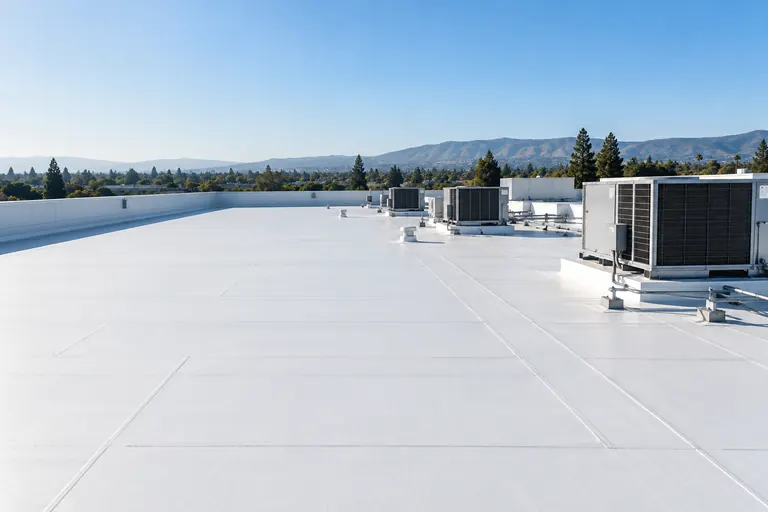
Replacement & re-roofing
Commercial Roof Replacement and Re-Roofing in the Bay Area
For a roof that's been patched too many times, a capex line or a reserve-study item coming due. Understand the decision and the code before you ask for bids.
- Free roof condition report first
- Good, better and best bid packages
- Certificate of insurance within 24 hours of request
Repair, restore or replace? How to tell
Replace when the problems are widespread rather than isolated. These are the signals, not prices:
| Option | Signals that point to it |
|---|---|
| Repair | Isolated leaks, a sound membrane and dry insulation. |
| Restore or coat | The membrane is intact, there's little wet insulation and the deck is sound (industry guidance). |
| Replace | Widespread wet insulation, deck damage, repeated failures after repairs, or a roof that already has the maximum number of layers. |
A moisture survey, with core samples to confirm, settles the question. A visual look doesn't. Start with a free roof condition report.
Tear-off vs. recover
A recover puts a new roof over the existing one. A tear-off removes the old roof down to the deck. The 2025 California Building Code defines roof replacement as removing all existing layers of roof covering down to the deck (§1512.2).
When the code doesn't allow a recover
Under CBC §1512.3 (Roof Recover), a new roof can't go over an existing one where:
- the existing roof or roof covering is water-soaked or has deteriorated to the point that it isn't adequate as a base for more roofing;
- the existing covering is slate, clay, cement or asbestos-cement tile;
- the roof already has two or more applications of any type of roof covering.
The code also bars reinstalling rusted, damaged or deteriorated flashing, metal edgings and drain outlets (§1512.4). A recover also changes the insulation and flashing-height math in the next section.
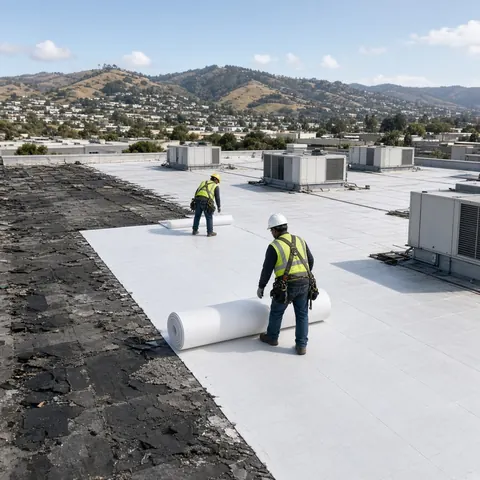
Illustrative image, not a completed project.
What Title 24 requires when you replace a low-slope commercial roof
California's Energy Code sets two separate requirements on a nonresidential low-slope re-roof: a cool-roof surface and, over conditioned space, insulation. Both are summarized in BayREN's 2025 Nonresidential Roofing Guide (updated June 1, 2026), which Bay Area building departments use.
Cool roof
The new surface needs aged solar reflectance of at least 0.63 and thermal emittance of at least 0.75, or an SRI of at least 75, with a CRRC label. It applies above the code's size threshold: more than 50% of the roof area or more than 2,000 square feet, whichever is less (Energy Code §141.0(b)2B). Roof area over unconditioned space, such as a warehouse, or process space isn't counted in that calculation (BayREN). That matters for tilt-ups with an office front and a warehouse behind: measure the areas separately. Our Title 24 re-roof guide walks through the trigger, the cool roof values and the insulation rule.
Insulation
When a low-slope roof over conditioned space is replaced, Table 141.0-C requires continuous insulation of R-23 in climate zones 1–5 and 9–16 (R-17 in zones 6–8). Most of our area is climate zone 3 (Oakland, San Francisco) or 4 (San José), so R-23 is the usual number. Confirm the zone for your address with the California Energy Commission's climate zone tool.
BayREN lists these exceptions:
- adding R-10 above the deck, where the guide allows it;
- where rooftop equipment won't be disconnected and lifted: insulate to the greater of R-10 or what keeps base-flashing height within the manufacturer's instructions;
- tapered insulation at drains, if the average meets the requirement;
- recoats, which aren't required to add insulation.
Compliance forms
BayREN lists the Certificate of Compliance (CEC-NRCCC-ENV-E) and the Certificate of Installation (CEC-NRCCI-ENV-E). Your contractor should prepare them with the permit, and the bid should say who does.
Permits for a commercial re-roof
Re-roofs are permitted work, and every city runs its own building department. Three examples of how much the thresholds differ:
- San José: a permit once 25% or more of the roof is replaced or repaired; commercial and industrial re-roof permits can be applied for online (Bulletin #201; SJPermits.org). See commercial roofing in San Jose.
- San Francisco: a DBI reroofing permit, which can be filed online only by a licensed C-39 roofing contractor and only with no structural or decking work; otherwise it's an over-the-counter permit (SF.gov). See commercial roofing in San Francisco.
- Sunnyvale: a permit when more than 100 square feet of roof covering is installed, repaired or replaced (sunnyvale.ca.gov). See commercial roofing in Sunnyvale.
Ask who pulls the permit. San José's own guidance is that whoever pulls it bears the liability.
How a re-roof runs on an occupied building
Condition report
Photos, findings and moisture evidence, so the scope rests on what's actually under the membrane.
Scope and options
Tear-off or recover, system, insulation and sheet metal, priced as good, better and best.
Permit and Title 24
The permit and the energy compliance forms, filed before work starts.
Notice and staging
Tenant or resident notice, parking, staging, protection and rooftop HVAC coordination.
Sections closed daily
Tear-off in sections that are dried in at the end of each day.
Inspections and closeout
City inspections, closeout photos and the paperwork for the owner or board.
Illustrative mockup, not an issued project document.
Compare three bids
What a good re-roof bid includes
Bids are only comparable when each one states the same things. Check every bid for:
- System, manufacturer, thickness and attachment method
- Insulation R-value and the tapered plan at drains
- Flashing, sheet metal, drains and overflows
- The Title 24 product and its CRRC listing
- Who pulls the permit and files the energy forms
- Warranty type and term, and the exclusions
Warranty basics
A contractor warranty covers workmanship and is issued by the roofer. A manufacturer warranty is issued by the membrane maker and usually requires an installer the manufacturer approves and an inspection at the end of the job. A manufacturer's NDL (no dollar limit) warranty covers covered repairs without a cap tied to the original price. Terms, exclusions and maintenance requirements vary, so ask every bidder for the actual warranty document.
Systems for a Bay Area re-roof
TPO
White, heat-welded single-ply. The most common re-roof system on the region's low-slope stock.
PVC
Heat-welded single-ply. KEE PVC is commonly specified near restaurant grease exhaust.
Modified bitumen
Multi-ply asphalt system, common on older apartment and commercial buildings.
Built-up (BUR)
Tar and gravel on older buildings. A roof with two or more layers has to come off.
Restoration coatings
For a sound roof that doesn't need replacing yet.
Who plans re-roofs with us
HOA boards & community managers
A defensible decision for the reserve-study item, with comparable good, better and best options for the board.
Property managers
A capex request the owner can approve: scope, phasing around tenants and documentation.
Industrial owners
A straight answer on whether a recover is allowed or the roof has to come off.
Where we work
Commercial, industrial, multifamily and HOA roofing across six Bay Area counties.
- Santa Clara County, CASan Jose, Santa Clara, Sunnyvale, Mountain View, Palo Alto, Milpitas
- San Francisco County, CASan Francisco
- San Mateo County, CARedwood City, San Mateo, South San Francisco, Burlingame, Foster City
- Alameda County, CAOakland, Fremont, Hayward, Newark, Pleasanton, Berkeley
Frequently Asked Questions
Replace when problems are widespread rather than isolated: wet insulation across large areas, deck damage, repeated leaks after repairs, or a roof that already has the maximum layers allowed. A moisture survey with core samples tells you which case you're in. If the membrane and deck are sound, a repair or coating may be enough for now.
Sometimes. California's building code allows a recover only when the existing roof is in suitable condition. It isn't allowed over a water-soaked or deteriorated roof, over slate, clay, cement or asbestos-cement tile, or where two or more roof applications already exist (CBC §1512.3). A core sample shows how many layers you have and whether the insulation is dry.
For most nonresidential low-slope roofs above the size threshold, the new surface must be a CRRC-rated cool roof (aged reflectance 0.63 and emittance 0.75, or SRI 75). A replacement over conditioned space generally also needs continuous insulation, R-23 in most Bay Area climate zones. BayREN lists exceptions for some equipment and drain conditions.
It depends on what's under the roof. The state guidance used by Bay Area building departments doesn't count roof area over unconditioned space, like an unheated warehouse, or process space when checking the size threshold. A mixed building with offices and a warehouse needs the areas measured separately.
It depends on roof area and access, tear-off versus recover, the layers to remove, deck repairs, the insulation the energy code now requires, the system and thickness, sheet metal and drains, rooftop equipment, permits and phasing around occupants. A free roof condition report and a good, better and best bid give you real numbers for your building.
Yes. Re-roofs are permitted work, and each city sets its own thresholds and process. San José, for example, requires a permit once 25% of a roof is replaced or repaired, while Sunnyvale requires one above 100 square feet of roof covering. Your contractor should pull the permit and file the energy compliance forms.
Let's get started
Request a re-roof bid
Tell us the property, roof size if you know it, and when the work needs to happen. Not sure you need a new roof? Ask for a free roof condition report first. For an active leak, call.
- (408) 770-5992Calling is fastest for an active leak