
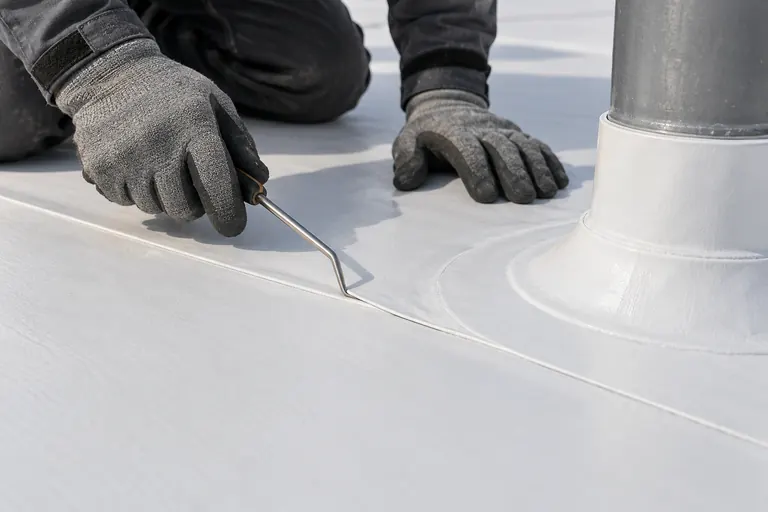
Sheet metal, flashing & drainage
Commercial Roof Flashing, Sheet Metal and Drainage Repair
Leak that keeps coming back? Check the flashing and the drains.
- Free roof condition report
- Photo-documented findings
- Certificate of insurance within 24 hours of request
Where flat roofs actually leak
Most leaks start where the membrane stops: wall and curb intersections, parapets and copings, penetrations, edges and drains. The 2025 California Building Code requires flashing “at wall and roof intersections, at gutters, wherever there is a change in roof slope or direction and around roof openings,” and metal flashing at least 0.019 inch thick (No. 26 galvanized sheet) (CBC §1503.2, §1503.2.1).
Parapets and coping
Parapets must be coped or covered, and the top must drain (CBC §1503.3). On Bay Area tilt-ups, panel joints under the coping are a common leak path.
Curbs, penetrations and crickets
A cricket or saddle is required on the ridge side of any penetration wider than 30 inches (CBC §1503.5). Rooftop HVAC curbs are the usual case.
Roof edges and gutters
Metal edge systems on low-slope built-up, modified bitumen and single-ply roofs must be designed for wind loads and tested to ANSI/SPRI/FM 4435/ES-1 (CBC §1504.6). Edge metal is engineered, not bent on site at random. Metal roof panels themselves are covered on metal roofing.
Counterflashing and termination bars
Where the membrane turns up a wall or curb, counterflashing and termination bars hold and cover the top edge. On single-ply roofs, see TPO roofing.
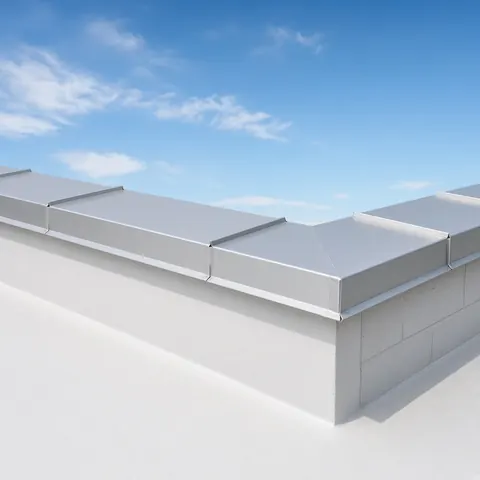
Illustrative image, not a completed project.
Drains, scuppers and overflow
Primary drainage: the California Plumbing Code sizes primary roof drains, gutters and leaders for a 60-minute, 100-year storm unless the local authority requires otherwise (CPC §1101.12.1).
Secondary (emergency overflow) drainage is required where the roof perimeter would trap water if the primary drains back up (CBC §1502.2; CPC §1101.12.2). The options are scuppers at least 4 inches high, or secondary drains set at least 2 inches above the roof surface, and a separate secondary system must discharge above grade where occupants or maintenance staff can see it. Local rules can add detail: South San Francisco’s re-roofing handout, for example, sizes overflow scuppers at 3 times the roof drains. Water pouring from an overflow scupper is a warning sign that the primary drains are blocked, not a fix.
On a re-roof
- Re-roofing a low-slope roof doesn't by itself require adding secondary drains or reaching ¼:12 slope where the roof has positive drainage and meets the structural ponding provisions, but existing secondary drainage can't be removed unless it's replaced (CBC §1512.1).
- Existing vent flashing, metal edgings, drain outlets, collars and counterflashing can't be reinstalled if rusted, damaged or deteriorated, and flashings must be rebuilt to the manufacturer's instructions (CBC §1512.4, §1512.5). That's a useful point when comparing bids. See commercial roof replacement.
Is ponding water a problem?
Water weighs about 62.4 pounds per cubic foot, so each inch of ponded water adds about 5.2 pounds per square foot. Ponding also speeds membrane aging and hides damage.
Common fixes
- Clear and repair drains
- Add crickets or tapered insulation
- Reset drain bodies at low points
- Add overflow drainage where it's required
Tapered insulation at drains is also an exception in the Title 24 insulation rules (BayREN), so it comes up in re-roof bids. Our Title 24 re-roof guide walks through the trigger, the cool roof values and the insulation rule.
Bay Area timing
At the NOAA stations we checked across the region, most of the year's rain, roughly 81–86%, falls November through March (1991–2020 normals, NCEI). Flashing and drain work belongs in late summer and fall.
Bay-shore and coastal buildings see more salt air, so corrosion-resistant metals and coatings matter more there. Fall drain clearing is part of a roof maintenance program.
Illustrative mockup, not an issued project document.
Sheet metal and drainage
What we work on
Every visit is documented with photos, so you can see the detail behind the leak.
- Coping and parapet caps
- Counter-flashing at walls and curbs
- Scuppers
- Gutters and downspouts
- Leak tracing at flashings and drains, with a repair scope
Who calls us about flashing and drains
Property managers
A leak that keeps coming back after patches, documented with photos to forward to the owner.
Owners and facility teams
Tilt-ups with parapets and interior drains.
HOA community managers
Flat sections, scuppers and gutters over walkways.
Where we work
Commercial, industrial, multifamily and HOA roofing across six Bay Area counties.
- Santa Clara County, CASan Jose, Santa Clara, Sunnyvale, Mountain View, Palo Alto, Milpitas
- San Francisco County, CASan Francisco
- San Mateo County, CARedwood City, San Mateo, South San Francisco, Burlingame, Foster City
- Alameda County, CAOakland, Fremont, Hayward, Newark, Pleasanton, Berkeley
Frequently Asked Questions
Repeated leaks in one spot usually trace to a detail, not the field of the roof: flashing at a wall or curb, a coping joint on a parapet, a penetration without a cricket, or a drain that's backing up. Patching the membrane won't hold if the flashing behind it has failed. A photo-documented inspection finds the source.
Yes, if it lingers. Each inch of standing water adds about 5.2 pounds per square foot, and ponding speeds membrane wear and hides damage. Common fixes are clearing and repairing drains, adding crickets or tapered insulation, and resetting drains at low points. Overflow scuppers running after storms are a warning sign.
Where parapets or other perimeter construction would trap water, California's building and plumbing codes require secondary drainage: scuppers at least 4 inches high or overflow drains set at least 2 inches above the roof. On a re-roof, existing overflow drainage can't be removed unless it's replaced.
Only if it's sound. The California Building Code bars reinstalling rusted, damaged or deteriorated vent flashing, metal edgings, drain outlets, collars and counterflashing on a re-roof, and flashings must be rebuilt to the roofing manufacturer's instructions. Compare bids on whether they include new flashing and edge metal.
A commercial roofer that works on sheet metal as well as membranes. The code requires parapets to be coped or covered with a top that drains, and tilt-up panel joints under the coping are a common leak path. Commercial Roofing Inc. works on coping, parapet caps and counter-flashing. Call (408) 770-5992.
Let's get started
Request a flashing or drain repair
Tell us the property, where the water is showing and what's been tried. For an active leak, call.
- (408) 770-5992Calling is fastest for an active leak