
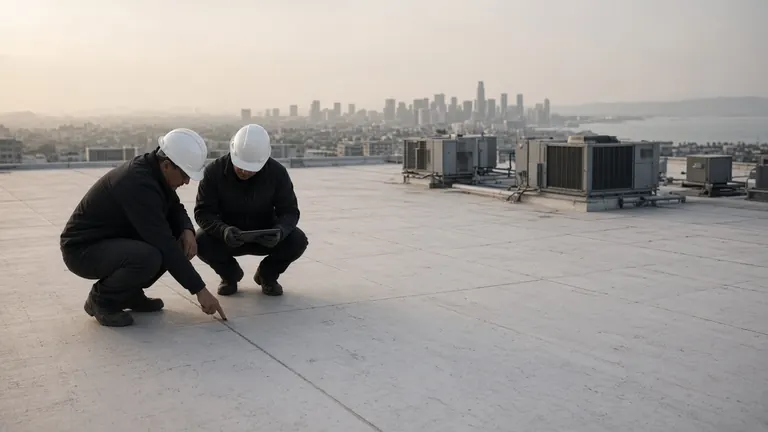
Preventive maintenance
Commercial Roof Maintenance Programs for Bay Area Buildings
Put your roofs on a schedule: fewer emergency calls, and a dated record of every visit for owners, boards and insurers.
- Start with a free roof condition report
- Photo report after each visit
- Certificate of insurance within 24 hours of request
What a maintenance program is, and why it pays to do it before the rain
A roof maintenance program is scheduled inspections, drain and debris clearing, small repairs before they turn into leaks, and a written record of each visit.
Bay Area timing
The National Weather Service reports that about 82% of San Jose's annual rain falls from November through March, and NOAA's 1991–2020 normals make December the wettest month at both Oakland's airport (3.84 inches) and SFO (4.14 inches).
So the fall visit, in September or October, is the one that matters most. A spring visit catches what the winter did and plans dry-season repairs. The baseline is a free roof condition report.
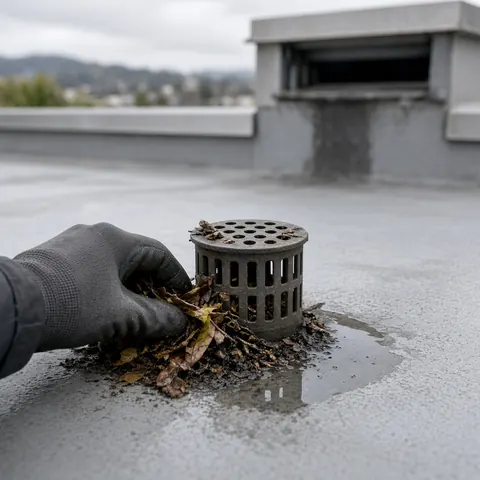
Illustrative image, not a completed project.
How often? What manufacturers say
Roofing manufacturers' owner maintenance guides commonly call for regular inspections, typically twice a year, and inspections after severe weather. Your roof's own manufacturer documents are the ones to follow, so keep them with the building records.
Illustrative mockup, not an issued project document.
Summary list
What a maintenance visit should look at
A short summary, not a full checklist. Standing water is heavy, about 5 lb per square foot for every inch of depth, so drains get attention every visit.
- Membrane, seams and flashings at curbs, parapets and penetrations
- Sheet metal: coping, counter-flashing and edge metal
- Drains, scuppers and gutters, cleared of debris
- Rooftop equipment curbs, skylights and hatches
- Signs of ponding, and an interior ceiling check where accessible
Maintenance and your roof warranty
Manufacturer roof warranties typically list owner obligations, which can include routine maintenance and keeping records of repairs. Read the terms of your warranty document. A maintenance program keeps the records your warranty may require: dated photo reports from every visit, so you can show the roof was cared for if you ever file a claim.
Reports you get after each visit
A photo report with findings and recommended repairs.
- For property managers: one document to forward to the owner or asset manager. See roofing for property managers.
- For HOAs: something the board and the reserve specialist can use alongside the reserve study's three-year visual inspection (Davis-Stirling). See HOA and condo roofing.
Portfolios and multiple buildings
If you manage several roofs, a program puts every building on the same calendar with one set of reports, instead of reacting to leak tickets one at a time. Start with a condition report on each roof to set the baseline.
A program vs. calling when it leaks
| Planned program | Calling when it leaks | |
|---|---|---|
| Timing | Work scheduled in dry weather, before the rains | Repairs during storms, when temporary fixes are all that's possible |
| Documentation | A dated photo record of every visit | Records only after something has gone wrong |
| Tenants and residents | Notice in advance, work planned around them | Disruption when water is already coming in |
| Small defects | Found and fixed at the seam, flashing or drain | Found after they've turned into a leak |
Who puts roofs on a program
Property managers
Fewer emergency calls, and a report to forward to the owner after every visit.
HOA boards & community managers
Roof care documented in a way that lines up with the reserve study.
Facility teams
Rooftops with heavy equipment and service traffic, kept on a calendar.
Where we work
Commercial, industrial, multifamily and HOA roofing across six Bay Area counties.
- Santa Clara County, CASan Jose, Santa Clara, Sunnyvale, Mountain View, Palo Alto, Milpitas
- San Francisco County, CASan Francisco
- San Mateo County, CARedwood City, San Mateo, South San Francisco, Burlingame, Foster City
- Alameda County, CAOakland, Fremont, Hayward, Newark, Pleasanton, Berkeley
Frequently Asked Questions
Scheduled inspections, usually in fall and spring, plus clearing drains and debris, fixing small defects at seams, flashings and penetrations, and a written photo report after each visit. The goal is to catch problems before the rainy season and keep a record for owners, boards and warranties.
Roofing manufacturers' maintenance guides commonly recommend regular inspections, typically twice a year, and after severe weather. In the Bay Area, schedule one visit in September or October before the rains and one in spring to catch winter damage.
If you manage several roofs, a program puts every building on the same schedule with one set of reports, instead of reacting to leak tickets one at a time. It also gives owners and insurers a documented history. Start with a condition report on each roof to set the baseline.
Often, yes. Manufacturer roof warranties typically list owner responsibilities, which can include routine maintenance and keeping records of repairs. Read your warranty's terms, and keep dated photo reports from every maintenance visit so you can show the roof was cared for if you ever file a claim.
Early fall. Most of the region's rain falls November through March, and December is the wettest month at both Oakland's airport and SFO in NOAA's 1991–2020 normals. A September or October visit clears drains and fixes small defects before the first big storm.
Let's get started
Put your roofs on a pre-rain schedule
Tell us how many buildings and where they are in the notes, and when you'd like the first visit. For an active leak, call.
- (408) 770-5992Calling is fastest for an active leak