
South San Francisco · San Mateo County
Commercial Roofing in South San Francisco: Lab, Industrial and Office Roofs
Lab, industrial and office roofs across South San Francisco.
- Free roof condition report
- Good, better and best bid options
- Certificate of insurance within 24 hours of request
Roofs on the Peninsula's biggest lab market
Cresa counts 13,302,963 square feet of lab space in South San Francisco at 28.9% vacancy, with net absorption of −9,698 square feet in the quarter. The city accounted for 40% of the quarter's Bay Area lab deals and 29% of leasing volume (Bay Area Life Science, Q1 2026). Market-wide, Cresa also reports more than 400,000 square feet of space built for life science leased to advanced manufacturing users over six months.
What that means on the roof
Lab and industrial roofs carry dense rooftop equipment: air handlers, exhaust stacks and piping. Re-leasing and conversions bring roof assessments, and the city's re-roofing rules check those equipment details. See roof condition reports.
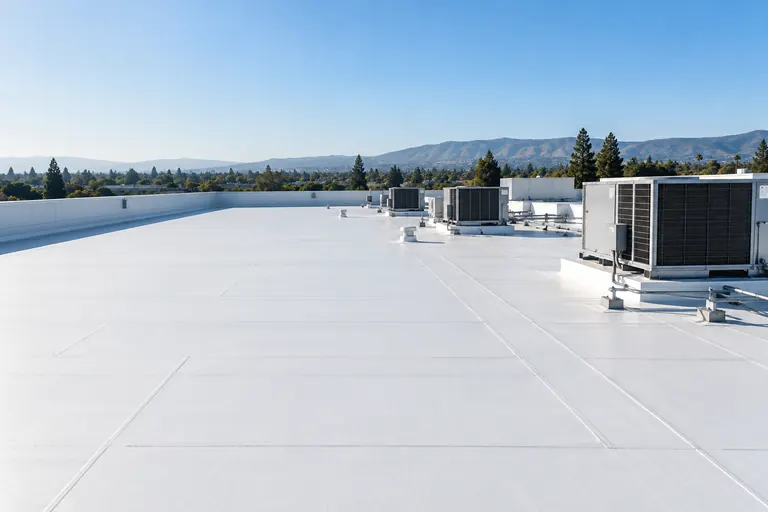
Illustrative image, not a completed project.
South San Francisco's re-roofing rules
From the city's “Re-roofing Requirements, Residential & Commercial Projects” handout and its Plan Submittal page. Check the current version with the city before you plan a job.
Permit and inspections
- Re-roofing is an over-the-counter permit through the Online Permitting Center. Anyone paid to do permitted work in South San Francisco needs a City business license. A lessee may pull a permit on a non-residential building if the lease allows.
- Keep the job card on site and request an inspection before work starts. An in-progress inspection happens before more than 50% of the new covering is applied, plus a nailing inspection if new plywood goes down.
- Only one overlay is allowed, and it needs a pre-inspection. The inspector's ladder must be rated for at least 250 lb, tied off, and extend 3 rungs above the roof.
Rooftop equipment (all buildings except single-family)
Fixed-ladder access to equipment, condensate drained to an approved receptor, and conduit and piping strapped to pressure-treated blocks adhered to the roof. On lab and industrial roofs, those details get checked at re-roof.
Parapet roofs where water can collect
Roof drains plus secondary overflow drains or scuppers sized per the plumbing code: overflow inlets 2 inches above the roof's low point, overflow scuppers 3 times the size of the roof drains and at least 4 inches high, and overflow piping not connected to the primary drain line. Crickets go behind vertical elements wider than 30 inches, and damaged flashing gets replaced. See flashing, sheet metal and drainage.
South San Francisco weather on roofs
NOAA's SFO station, which adjoins the city (1991–2020 normals): 19.64 inches of rain a year, 85% of it November through March, with December wettest at 4.14 inches. Summers stay cool: the warmest month is September, at an average high of 74.8°F (NCEI).
Wind-driven winter rain and marine air are the issue here, not heat: salt air works on sheet metal, fasteners and equipment curbs. See roof maintenance programs.
Title 24
ZIP 94080 is in climate zone 3 (CEC ZIP list). On nonresidential low-slope roofs, California's Energy Code applies cool-roof requirements when the area replaced, recovered or recoated is more than 50% of the roof or more than 2,000 square feet, whichever is less (Energy Code §141.0(b)2B). The new surface must be a CRRC-rated product that meets the code's reflectance and emittance minimums, and a re-roof over conditioned space in Bay Area climate zones 3, 4 and 12 generally also needs R-23 continuous insulation (BayREN, Table 141.0-C). Recoats are exempt from the insulation rule. Our Title 24 re-roof guide walks through the trigger, the cool roof values and the insulation rule.
Who we work with in South San Francisco
Facility teams
Repairs and re-roof scopes for industrial, office and flex buildings, documented with photos.
Property managers and owners
A condition report before re-leasing, a line-item scope, and a COI within 24 hours of request.
Owners planning a re-roof
A scope that includes the city's equipment and overflow details, priced as good, better and best.
Nearby
San Francisco: north, with DBI permit rules and the same fog-belt weather.
Daly City: west, a townhome and apartment city in the fog belt.
Brisbane and San Bruno: neighboring cities on the bay side.
The rest of the county: commercial roofing in San Mateo County.
Frequently Asked Questions
An over-the-counter permit, a job card on site, and inspections before and during the work. The city's handout allows only one overlay (with a pre-inspection), requires an in-progress inspection before half the new covering is applied, and sets rules for rooftop equipment access, condensate lines, and parapet overflow drains or scuppers.
Yes, where water can collect behind a parapet. The city's re-roofing handout calls for roof drains plus secondary overflow drains or scuppers sized per the plumbing code. Overflow inlets sit 2 inches above the low point, scuppers are 3 times the drain size and at least 4 inches high, and overflow lines stay separate.
Commercial Roofing Inc. repairs, maintains and replaces low-slope roofs on South San Francisco industrial, office and flex buildings. You get a photo report and good, better and best options, and a COI within 24 hours of request. Call (408) 770-5992 or request a bid.
It may. For buildings other than single-family homes, the city's re-roofing handout requires fixed-ladder access to rooftop equipment, condensate drained to an approved receptor, and conduit and piping strapped to pressure-treated blocks adhered to the roof. Budget for those details in the re-roof scope.
Let's get started
Request a bid for a South San Francisco building
Tell us the property, the building type and what you need. Bid invites and plans are welcome. For an active leak, call.
- (408) 770-5992Calling is fastest for an active leak