
Roof systems · PVC
PVC Roofing for Commercial Buildings: Restaurants, Grease Exhaust and Re-Roofs
For restaurants, retail centers with food tenants and food-service buildings, and for existing PVC roofs with seam or flashing leaks.
- Free condition report: repair, coat or replace?
- Good, better and best options
- Certificate of insurance within 24 hours of request
What PVC and KEE PVC are
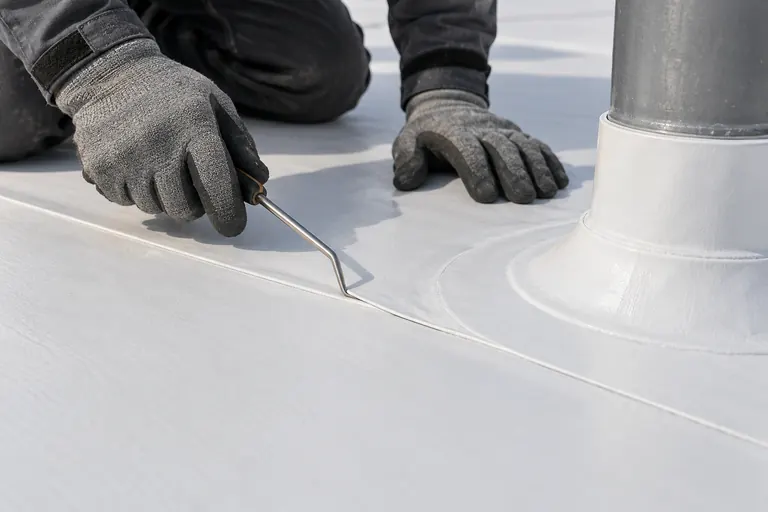
PVC (polyvinyl chloride) is a thermoplastic single-ply membrane with heat-welded seams, like TPO. The standard material specification is ASTM D4434, which covers fiberglass-reinforced (Type II) and polyester-reinforced (Types III and IV) sheets. Depending on the reinforcement, it's installed adhered, mechanically attached or induction-welded (ASTM D4434; GAF's published product data).
KEE PVC blends a solid polymer plasticizer (ketone ethylene ester) in with liquid plasticizers. GAF's published data notes that no membrane on the market uses solid plasticizers alone.
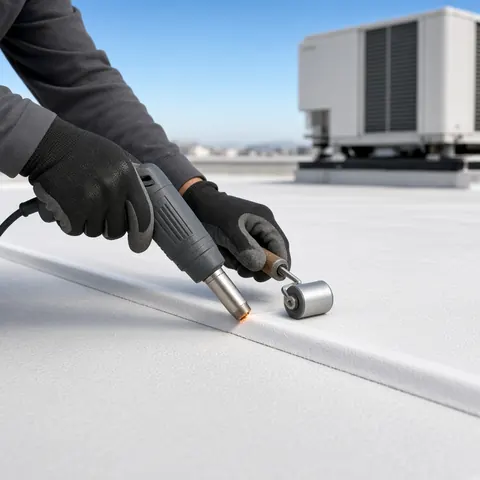
Illustrative image, not a completed project.
Why restaurant and food-service roofs often get PVC
GAF's published data shows that PVC and KEE PVC have high resistance to animal fats, grease and vegetable oils when tested to ASTM D543, and GAF recommends them for restaurants and food-processing plants. Depending on the exposure, GAF's data says KEE PVC “may exhibit fewer property changes” (GAF building-science blog, July 31, 2026).
Brand names on this page are cited for reference only, as the source of that manufacturer's own published data.
A membrane isn't grease control
Grease that pools around kitchen exhaust fans still needs containment and regular cleaning, whatever the membrane. Ask the manufacturer how its warranty treats grease exposure, and keep the cleaning records.
You'll see this on retail strips and centers with food tenants, freestanding restaurants, commissaries and food-processing buildings in industrial areas.
Where PVC roofs fail
Around kitchen exhaust fans
Where grease collects. Membranes that don't resist it can soften, shrink or blister.
Seams and curb flashings
Where the membrane is welded and where it turns up at equipment.
Penetrations
Pipes, conduit and supports added during rooftop service.
Ponding at drains
Standing water at blocked or undersized drains.
Repair, coat or re-roof a PVC roof?
| Option | Usually fits when |
|---|---|
| Repair | The PVC is clean and weldable, so seams and flashings can be patched and re-welded. Grease-contaminated membrane has to be cleaned or cut out first, following the manufacturer's instructions, or the weld won't hold. |
| Coat | Only with a coating the manufacturer lists as compatible with PVC, after an adhesion test, and not where grease exposure continues. |
| Re-roof | The membrane is embrittled across the roof, it has shrunk at the perimeters, or the insulation is wet. |
If the roof is still under a manufacturer's warranty, check its repair requirements before anyone works on it. A roof condition report is the place to start.
PVC and Title 24
On nonresidential low-slope roofs, California's Energy Code applies cool-roof requirements when the area replaced, recovered or recoated is more than 50% of the roof or more than 2,000 square feet, whichever is less (Energy Code §141.0(b)2B). The new surface must be a CRRC-rated product that meets the code's reflectance and emittance minimums, and a re-roof over conditioned space in Bay Area climate zones 3, 4 and 12 generally also needs R-23 continuous insulation (BayREN, Table 141.0-C). Recoats are exempt from the insulation rule. The low-slope surface needs aged solar reflectance of at least 0.63 and thermal emittance of at least 0.75, or an SRI of at least 75, with a CRRC label (§140.3(a)1A). Our Title 24 re-roof guide walks through the trigger, the cool roof values and the insulation rule.
White PVC is commonly CRRC-listed. As one manufacturer's example, GAF's published data shows an aged SRI of 93 for its KEE PVC and 86 for its standard PVC (CRRC values). Check the specific product's CRRC listing.
Roof area over unconditioned space doesn't count toward the cool-roof rules, and minor leak repairs don't need CRRC-rated products (CEC 2025 Nonresidential Cool Roofs FAQ).
PVC vs. TPO
Both are white, heat-welded single-ply membranes that can meet California's cool-roof rules. What usually decides it is what comes out of the rooftop equipment.
| PVC / KEE PVC | TPO | |
|---|---|---|
| Chemistry | Polyvinyl chloride; KEE adds a solid polymer plasticizer | Thermoplastic polyolefin |
| Seams | Heat-welded | Heat-welded |
| Grease and oils | Recommended for restaurants and food processing in GAF's published data | Check the manufacturer's guidance |
| Typical uses | Restaurants, food-service and food-processing roofs | Tilt-ups, R&D, offices and retail without grease exposure |
Where we work
Commercial, industrial, multifamily and HOA roofing across six Bay Area counties.
- Santa Clara County, CASan Jose, Santa Clara, Sunnyvale, Mountain View, Palo Alto, Milpitas
- San Francisco County, CASan Francisco
- San Mateo County, CARedwood City, San Mateo, South San Francisco, Burlingame, Foster City
- Alameda County, CAOakland, Fremont, Hayward, Newark, Pleasanton, Berkeley
Frequently Asked Questions
Manufacturers commonly recommend PVC or KEE PVC, because those membranes resist animal fats, grease and cooking oils in testing, and GAF's published data shows KEE PVC may have fewer property changes where exposure is heavy. Grease still has to be contained and cleaned at the exhaust fans; no membrane is a substitute for that.
Both are heat-welded thermoplastic single-ply membranes. KEE PVC adds a solid polymer plasticizer, ketone ethylene ester, alongside the liquid plasticizers, which manufacturers say improves chemical resistance. Neither is made with solid plasticizers alone, whatever some marketing implies. Check each product's data sheet and CRRC listing.
Usually. Clean, weldable PVC can be patched and re-welded at seams, flashings and penetrations. Grease-contaminated areas have to be cleaned or cut out first, or the weld won't hold. If the membrane has turned brittle or shrunk at the edges, or the insulation is wet, a re-roof is usually the better value.
Neither across the board. Both are white, heat-welded single-ply membranes that can meet California's cool-roof rules. Where kitchen exhaust or oils reach the roof, manufacturers point to PVC or KEE PVC. Without that exposure, TPO is widely used. Match the membrane to what comes out of the rooftop equipment.
On nonresidential low-slope roofs, yes, once more than 50% of the roof area or more than 2,000 square feet, whichever is less, is replaced, recovered or recoated. The product must be CRRC-rated with at least 0.63 aged reflectance and 0.75 emittance, or SRI 75, and conditioned space generally needs added insulation.
Let's get started
Request a PVC re-roof bid
Tell us the property, the tenants' use (restaurant or food service especially) and whether it's a leak, a repair or a re-roof. For an active leak, call.
- (408) 770-5992Calling is fastest for an active leak